Read the buildings at Plano’s Heritage Farmstead
Make a farm visit about the jobs a house, yard, and outbuildings once had to perform.
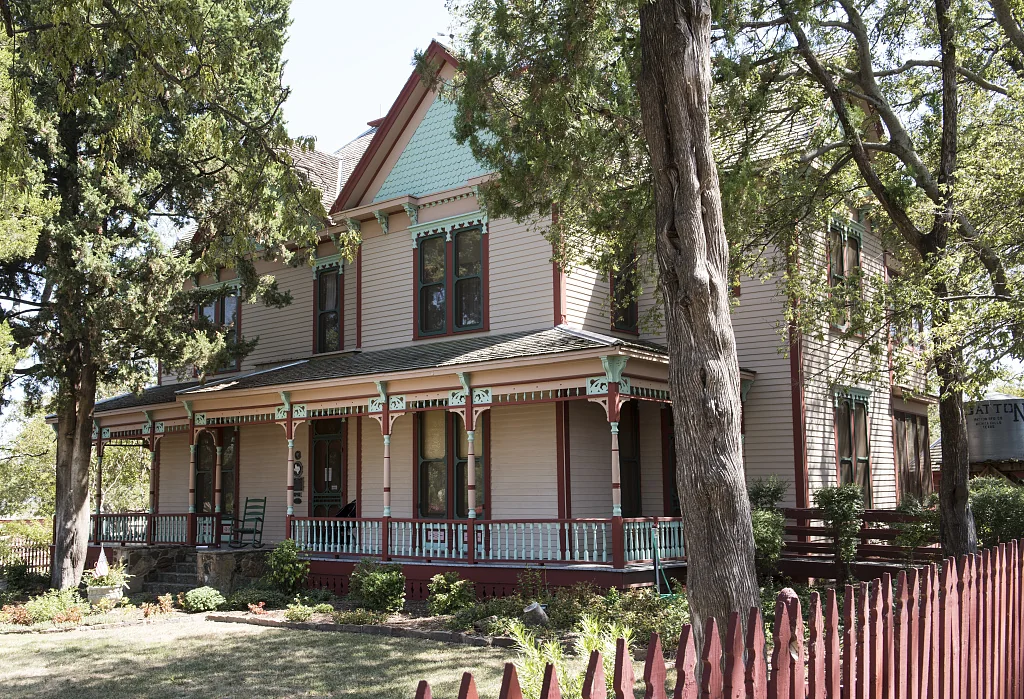
A child standing at the fence of Plano’s Heritage Farmstead can start with a concrete question. Where would a person take something that needed to be kept dry, washed or carried to the field? The house is the most conspicuous building, but the site map names places for storing crops, caring for animals, washing and working with equipment. Pick a few of those jobs. By following how somebody might have moved between two buildings, a visitor can begin to understand why a farm required more than a place to live.
The Heritage Farmstead Museum at 1900 West 15th Street preserves buildings and collections related to life on the North Texas Blackland Prairie. The Library of Congress’s record for Carol M. Highsmith’s 2014 house photograph identifies the late Victorian home as an 1891 building associated with Mary Alice and Hunter Farrell. Their daughter Ammie Wilson later ran the farm and became an award-winning livestock breeder. The museum opened in 1986. Its map describes the preserved site, a small piece of the much larger working property described in the historical record. Library of Congress photograph and catalog record
Make the first stop about the needs of the house
Use the porch and fence as things a younger visitor can recognize before entering any room. Ask what a porch gives a person going from the yard into the house. A roof can make shade while somebody stops to talk or prepares to go back out, and the porch creates a transition between an indoor room and activity close to the building. Ask where you can see a door that opens to the porch and how the roof relates to the opening. You can do this from an approved path or with the dated photograph if a child would like time before the visit.
The museum’s Farrell-Wilson House education material lists porch shade, screened doors and transoms in a discussion of how the household dealt with heat. It also discusses fireplaces for cold weather. Those features are easiest to understand in relation to jobs. Look for a transom if a guide says it is visible on your route and ask what an opening high above a door could do. From outdoors, ask which side of the house offers shade at your visit time. Treat the shade you see as an observation for that hour without assigning it to every season.
Use names on the map to choose the next job
Take a look at the museum grounds map and choose two destinations before starting across the site. The map labels the wash shed, laundry, corn crib, implement shed, carriage house and other places alongside the Wilson House. Its layout is useful for comparing what appears near something else. The illustration is marked as not to scale, so use the posted paths and actual conditions to plan the walk. A room or building shown on a map may have its own hours or viewing limits. Ask staff what parts can be visited that day.
Try comparing the label of the farm shop with the label of the carriage house. What would people need to carry into a workshop, and what kind of doorway would make it easier to bring in transportation equipment? Those questions give a reason to look at the size of an opening, the space in front of it and its connection to another work area. If a museum sign names what happened there, use it to see which ideas fit. An opening can suggest a use from its shape, and a dated site record can help establish how a specific building actually worked.
Trace a job with an object that has to move
Ask a child to imagine a bucket or a clean shirt as the starting point of a route. Near a building the map associates with washing, think about where a person might collect the things that needed cleaning, where the work took place and how something dry would make it back to its owner. If the museum is displaying a period item, ask a guide which part of the job it helped perform. Use the label and the space around it to make the connection. The whole route can be drawn as three points, including a place for the work and a place for the finished item.
A job involving a crop might give you a different path. The map identifies a corn crib, a root cellar and a sorghum mill. Each name opens a different question about keeping, storing or handling something grown on a farm. Ask which feature is used for the museum’s interpretation and what clues it provides to the original work. A child can notice if something sits above or below the surrounding ground, or whether the exterior offers gaps for air or has solid walls. Check the sign or ask the guide before treating a visible feature as proof of a specific historical use.
Include an animal stop if the day’s route allows it
The museum identifies its animals as part of how the site shows farm life. Its grounds map labels the ram barn, lambing barn, hen house and other animal areas. Choose a place staff say you can view from a public route. A useful question is what needs to happen for the animals to be housed, fed, watered or moved safely. Look for a fence, gate or feeding area that the museum identifies. The work may involve several visits every day, so it gives the group a reason to think about the distance between the house and the animal areas.
The museum’s student guidance asks visitors to observe animals without touching or chasing them and to stay behind barriers. Confirm the visitor instructions for your date and follow staff directions about the permitted interaction. An animal may be somewhere else even if its enclosure appears on the map. Keep the question about the building useful either way. If the animal is out of view, ask what kind of opening or protected area the guide can point out. An enclosure shows at least one part of the task a working farm had to plan for. Heritage Farmstead field trip etiquette
Keep a large farmhouse in its own context
Do not use this one address as a picture of every farming household around Plano in the 1890s. The museum’s school material invites students to ask whether the Farrell-Wilson House was typical. It points to the number of rooms and colors of paint, its gardens and the size of the farm as details worth comparing. Give children a way to observe scale without deciding exactly how every room was used. The difference between a room used for visitors and a place for completing a daily household task can explain why certain features became especially noticeable.
Ask a guide what the museum knows about who performed a job. A large building shows where some work could take place, but a map by itself does not tell you which people did it, how often they were there or how their responsibilities changed. The catalog chronology gives a starting point for questions about the Farrell family and Ammie Wilson. If someone in the group notices a gap, write down which activity they want to learn about. That is a useful next question for the museum’s archival material or a future visit.
Plan the stop to fit the age and time of the group
The museum publishes its ordinary visitor window and information about tours, the grounds and programs. Check the museum’s current visit information for the date. Ask about the options to see the house and grounds, applicable admission and the route somebody with an access question should use. A short outdoor loop and a guided house stop can take different amounts of attention. If a child can comfortably focus on two or three observations, choose those before trying to cover every named structure.
Set a real meeting point if adults and children are observing in a small group. Give everyone an observation to bring back, such as where the house offers shade or which feature helps recognize the outbuilding. If the weather affects the walk or an area is occupied by a group, use what the museum makes available that day. A posted label near the house can answer the question you wanted to take to an outbuilding. A dated photograph can help you look again later without treating it as a view of the original 1891 surroundings.
Bring the question forward to a job at home
After the visit, ask each person to draw a short route for one task they know. Laundry might travel from a bedroom to a shared room and back. Storing food can involve a counter, a cupboard and a refrigerator. Compare the practical job with the example you discussed at the farm and see which parts of the route have changed. Give the map drawings labels. If nobody remembers exactly what an unfamiliar building did, check the museum’s map or material before adding a claim to the drawing.
Try sharing the diagram with someone who did not visit. Tell them where you saw the clue the map helped you find and what question remains about the job. An older photograph and a sign encountered at the museum can give different kinds of evidence. Keeping the drawing clear about dates and location lets the next visitor pick up the question at the same fence, porch or path and look at it from their own point of view.
Find more local visits in the Plano Beacon archive.